


This contemporary artist’s photorealistic images of candles stem from his desire to break free from reality and prejudice.
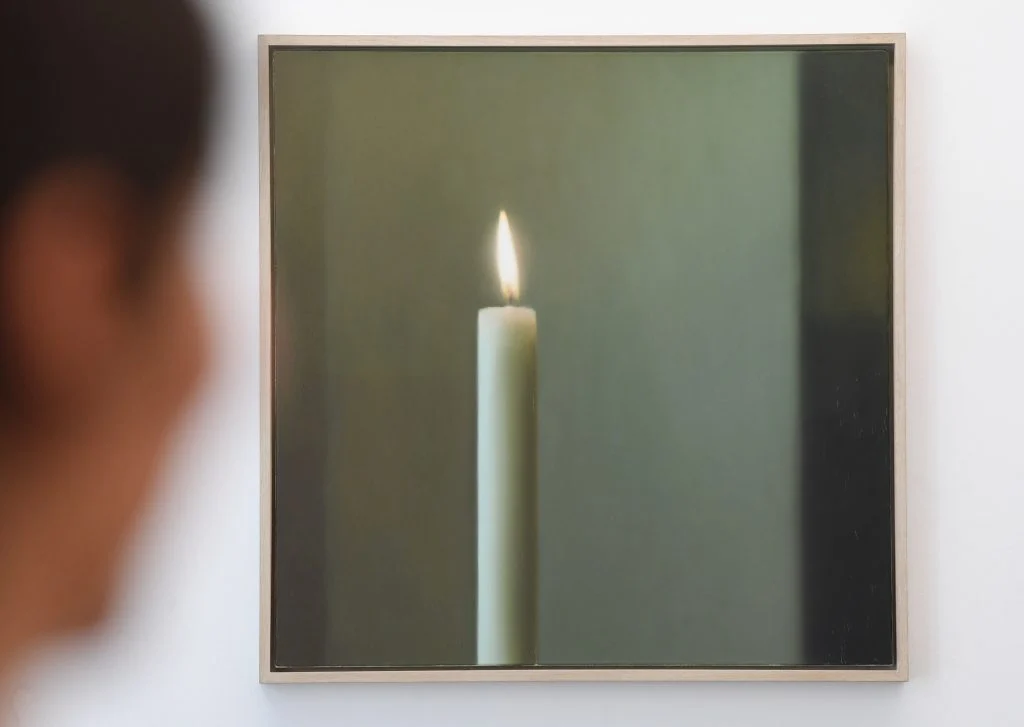
At first glance, Gerhard Richter’s candle paintings appear to be blurry photographs. In reality, they are meticulously crafted paintings that recreate the effect of a camera focusing slightly out of focus. Richter’s candles—one of which, titled Kerze, sold in 2011 for over $13 million—oscillate between reality and illusion, objectivity and subjectivity, much like the artist spent his youth in East Germany, caught between capitalist Europe and communist Russia.
Richter, now one of the most successful contemporary artists in the world, with retrospectives at the Museum of Modern Art and Tate Modern, was born in 1932 in Dresden, seven years before the start of World War II. He began drawing at age 15, attending an art school in East Germany, where his training was steeped in Socialist Realism, a representational art movement that promoted the ideology of the Communist Party.
Although his early projects—including a mural for the German Hygiene Museum—were well-received, Richter was dissatisfied with Socialist Realism, which, in his opinion, stifled artists’ creativity. Equally critical of capitalism and consumerism, he spent his adolescence searching for what Contemporary Art Issue magazine calls a “third way.”
A path opened up for him when, after moving to West Germany with his wife, Richter discovered the abstract work of Jackson Pollock and Lucio Fontana, and befriended the German painters Sigmar Polke, Blinky Palermo, and Konrad Fischer. Turning the critical gaze of socialist realism toward Western society, Richter produced paintings and photographs that commented on the media, current events, and popular culture, with television, advertising, and politicians among his favorite subjects.
Although his early projects—including a mural for the German Hygiene Museum—were well-received, Richter was dissatisfied with socialist realism, which, in his opinion, stifled artists’ creativity. Equally critical of capitalism and consumerism, he spent his adolescence searching for what the magazine Contemporary Art Issue calls a “third way.”
A path opened up for him when, after moving to West Germany with his wife, Richter discovered the abstract work of Jackson Pollock and Lucio Fontana and befriended the German painters Sigmar Polke, Blinky Palermo, and Konrad Fischer. Turning the critical gaze of socialist realism toward Western society, Richter produced paintings and photographs that commented on the media, current events, and popular culture, with television, advertising, and politicians being some of his favorite subjects.
The enduring popularity of Richter’s candle paintings can be partly attributed to his 1988 collaboration with the American band Sonic Youth, who used a 1983 painting as the cover art for their album Daydream Nation. Since then, his talent has not diminished.
What inspired Mary Cassatt’s portraits of mothers? Why did Jackson Pollock paint on the floor? Eureka investigates the origins of artists’ most famous works and techniques, unraveling how great artistic ideas emerge.


What do you think?
Show comments / Leave a comment