


Jacques-Louis David’s The Death of Marat is a deceptively simple image of a real-life murder. But a closer look at David’s iconic painting reveals the political messages contained within.
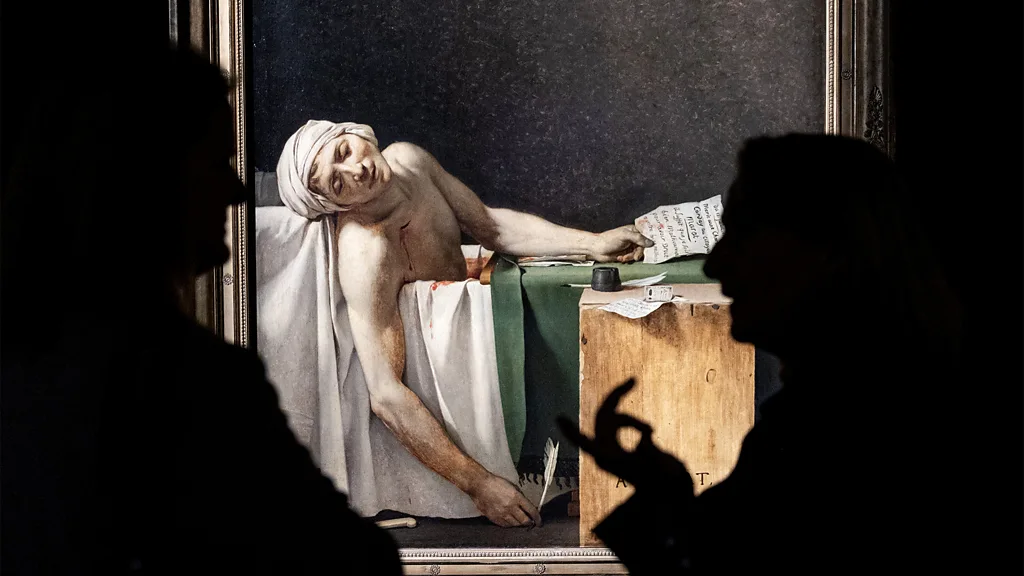
Great art makes us do a double take. It makes us look, then look again. Take The Death of Marat, 1793, perhaps the most famous crime scene depiction of the past 250 years. At first glance, the portrayal of the murdered body of the French revolutionary Jean-Paul Marat, stabbed to death in his bath on 13 July 1793, could hardly be simpler. The slain journalist, who had agitated for the execution of King Louis XVI, slumps towards us – his body framed by the vast flickering emptiness that stretches above him.
Warning: This article contains descriptions and images of violence that some readers may find upsetting
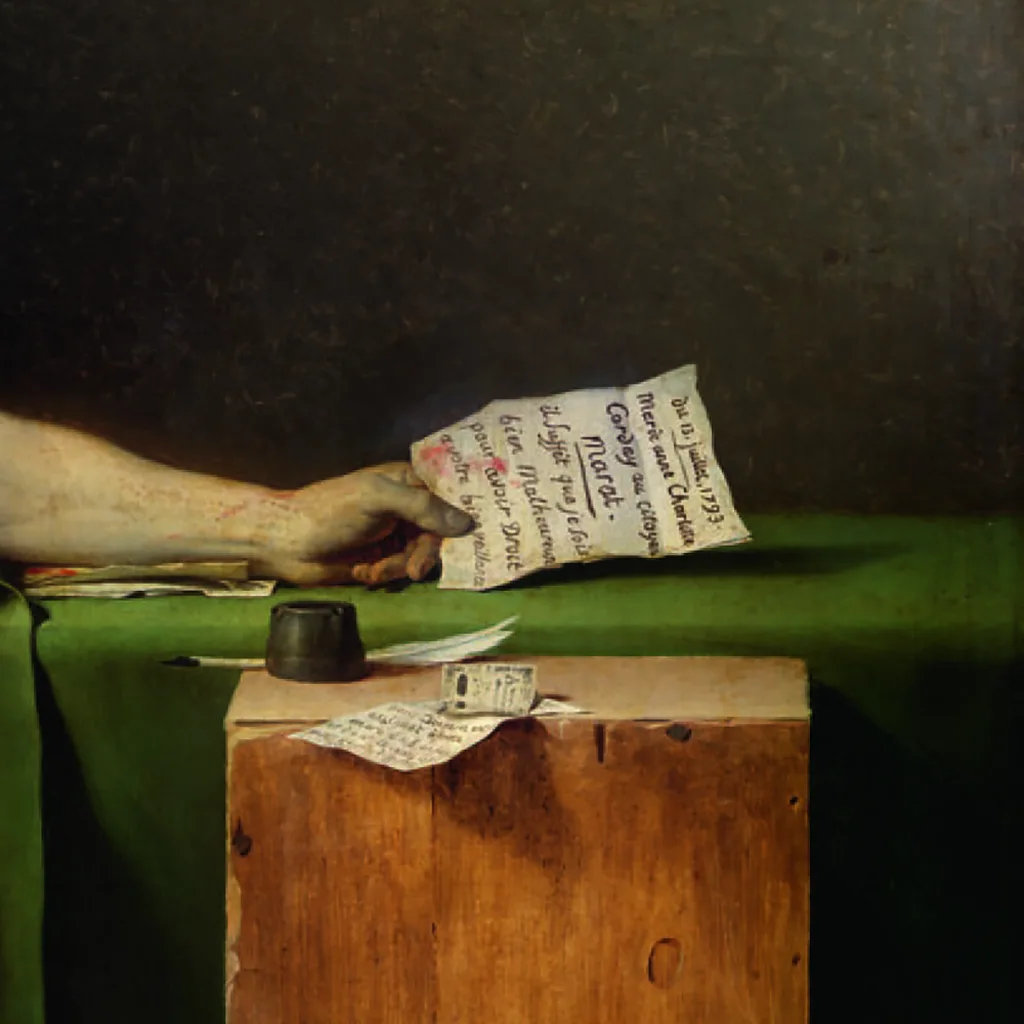
Lean in closer, however, and Jacques-Louis David’s iconic painting begins to break down into a complex puzzle of double details that unsettle the bottom half of the canvas – two quills, two dates, two letters, two absent women, two boxes, two signatures, two dead bodies. The cacophony of contrary clues draws us in, transforming us from passive observers of a straightforward snapshot of history to forensic detectives actively engaged in solving a deeper mystery, one in which the artist himself is suspected of having tampered with the evidence.
Everywhere you look in The Death of Marat, one of the masterpieces featured in a major exhibition of David’s work at the Louvre in Paris, there is proof of the artist’s dual determination to create both an intimate personal elegy for a murdered friend, whose radical politics the artist shared, as well as a piece of potent public propaganda. In David’s hands, Marat is much more than simply a Jacobin journalist into whose chest a French woman, Charlotte Corday, plunged a kitchen knife, believing he was poisoning public discourse. Marat is glorified: a second Christ.
David’s portrait exalts Marat, transfiguring him from a sickly real-life person, who required lengthy medicinal baths to soothe a chronic skin disease, into a sacrificed secular Messiah. To amplify that elevation from infirmed mortal to mystical martyr, David laces his painting with decodable ciphers and echoes of art history that keep our eyes firmly fixed on the myth he is weaving before them. So implicated is the artist in the choreography of the scene, it is easy to see how Sébastien Allard, curator of the Louvre exhibition, could reach the conclusion in his essay for the catalogue that “the monument David erects to Marat is also a monument that he builds for himself… Marat acts with his pen, the painter with his brushes”.
The two hands
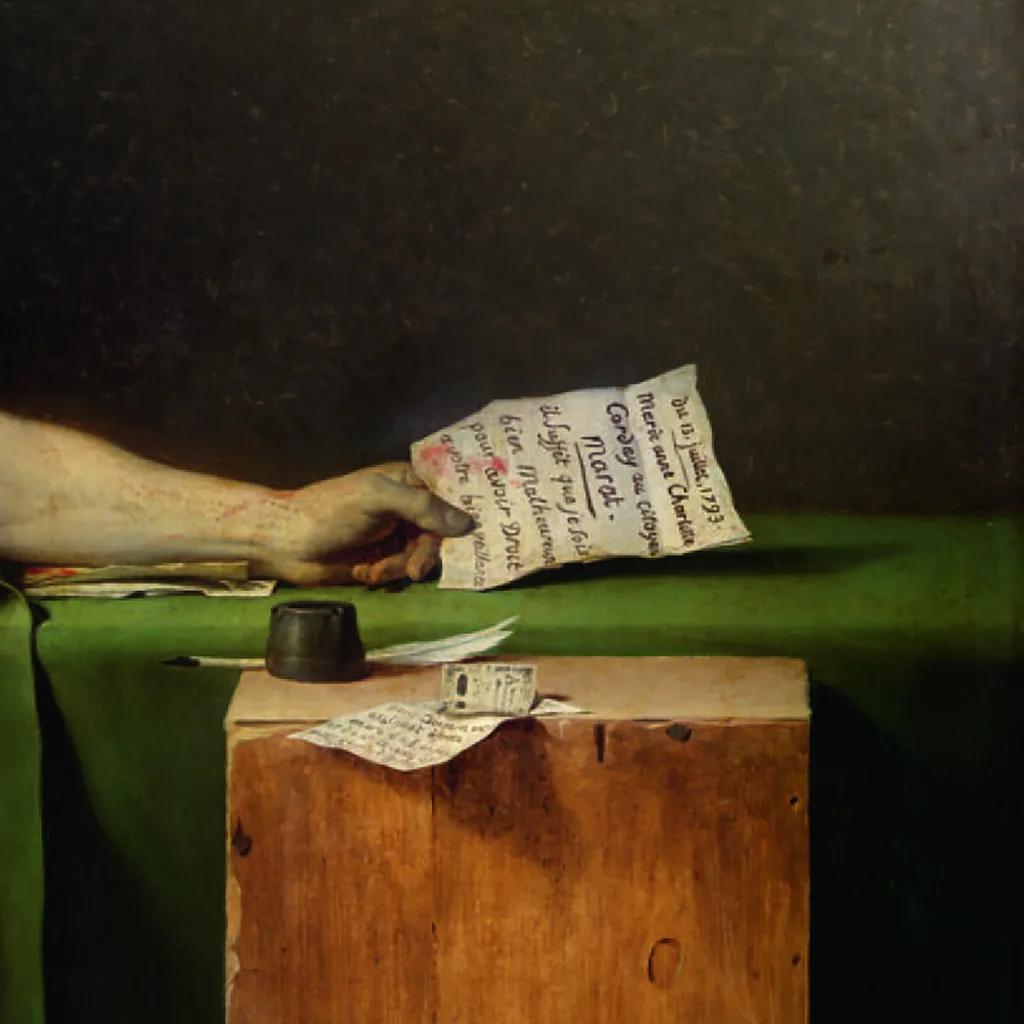
Our gaze is torn in two directions as it tries to trace the curiously contrary activities of the dead man’s moribund hands. In Marat’s right hand we find the quill with which he was writing when stabbed with the pearl-handled knife that lies only inches away. Knuckles to the floor, that hand dangles lifelessly downward in a manner that recalls Christ’s drooping arms in both Michelangelo’s monumental marble sculpture, Pietà, and in Caravaggio’s affecting painting The Entombment of Christ, 1603-4. Meanwhile, Marat’s left hand, rigid with rigor mortis, steadies a blood-smudged letter from the assassin, suggesting an entirely different focus of his attention. One hand clings to life, the other succumbs to death. Between these two diverging gestures, the painting’s spirit swivels, flexing forever between the world of the living and the world of the dead – this one and the next.
The two dates
Look closely below David’s signature and you will see a silent struggle not just between two different dates but between two contrary conceptions of time. Under his own name, David has chiselled “L’an deux”, denoting the second year of the Revolutionary Calendar which began in 1792, when the Republic was founded. That crisp and legible date sits between the prised apart and partially erased digits of the Christian calendar’s calibration for the year of the work’s creation: “1793”. In the bottom two corners of the box, David has inserted and scrubbed away “17” and “93”, indicating an utter abolition of Christian time in favour of revolutionary measurements.
Yet again, Marat may be making a rich allusion in his curious conflation of competing systems of time. Like Caravaggio, Botticelli too only signed one painting: his Mystic Nativity, into which he embeds a riddling inscription that brings into close adjacency the Christian calendar and an apocalyptic one that is synchronised to the Book of Revelations: “This picture, at the end of the year 1500, in the troubles of Italy, I, Alessandro, painted in the half-time after the time, according to the eleventh chapter of Saint John in the second woe of the Apocalypse…” In David’s Death of Marat, Botticelli is summoned and superseded as the priorities of revelation are usurped by those of revolution.
What, ultimately, does all this doubling add up to in David’s famous painting, a work that, by fusing passion with principle, would redefine the texture and intensity of history painting, and influence everything from Delacroix’s Raft of the Medusa to Picasso’s Guernica? By relentlessly refracting the evidence left at the scene of Marat’s murder through the dense prism of his imagination, David projects a double portrait. Before our eyes the artist transforms murder into myth as the physical body of the slain polemicist is alchemised into a mystical second figure we more feel than see. Marat the Messiah’s haunting presence disturbed the imagination of the French poet Baudelaire, who famously observed of the painting “in the cold air of this room, on these cold walls, around this cold and mournful bathtub, a soul hovers”.


What do you think?
Show comments / Leave a comment